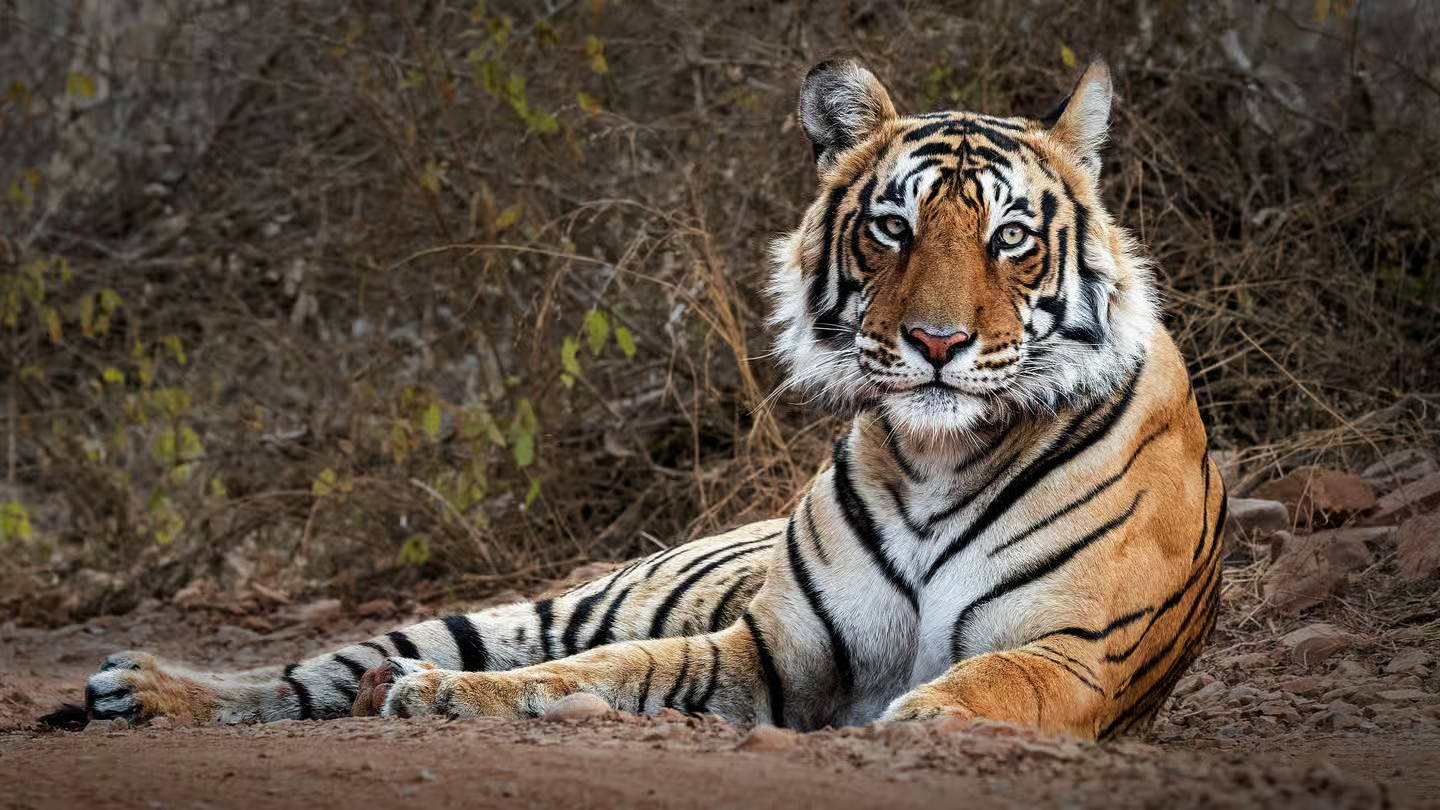
First light, and the track is red dust with the night still in it. The jeep rolls slow along a firebreak outside Moharli, engine cut, hand up. Fifteen metres ahead a tigress steps out of the bamboo, crosses the ruts without looking at us, and dissolves into teak shade on the far side. Forty seconds. No other vehicle. No commentary worth remembering.
That morning is the whole of this page.
Tadoba Andhari Tiger Reserve is not the park behind the fort, the park behind the river, or the park behind the legend. It is the park that offers the tiger itself. Close up, in dry country, with enough forest around the meeting for it to feel like a forest. Everything below is the case for that, with the limits left in.
What the forest is
Tadoba spreads across roughly 1,727 square kilometres of core and buffer in Chandrapur district, eastern Maharashtra, a long way from any coast. It sits almost directly south of Nagpur's Zero Mile Stone, the historic surveyed centre of the country, on nearly the same meridian. The middle of India, not its edge. Southern tropical dry deciduous forest. Teak over bamboo, open underneath in summer. The leaf litter carries sound a long way. In the cold months the understorey thins until a metre of orange and black has few places to hide.
Because the forest is dry, water is the economy. Telia, Tadoba and Jamunbodi lakes, plus a network of managed waterholes, hold through May while everything else gives up. The animals come to them, which is why sightings peak exactly when the calendar empties. The tiger you meet in May has walked to the same water as the sambar and the sloth bear. Nothing here is staged for you. It is a working landscape, and it is more honest for being one. How that readability shifts through the year is a longer story. We tell it in why density misleads and climate engines. The full figures sit on the climate page.
The numbers, read carefully
The 2022 national count placed 97 tigers here. The 2024 state camera-trapping round photographed 95 adults, with 41 cubs and sub-adults alongside them. Two counts, two conventions: one a published national total, the other a photographed state figure. Neither should be quoted against the other as a straight comparison.
What matters is not the headline but the spread. The 2024 monitoring found 36 tigers living entirely outside the core boundary, buffer-exclusive. That is the difference between a count and a sighting. The core is not always the better bet, and our core-or-buffer guide shows why, gate by gate. The forest filled back up, and the cats spilled outward into ground most visitors have never heard of. Read why density misleads before you trust any figure in this series, including this page's.
The odds, stated plainly: across our own guest book, where we ask every party what they saw on return, tiger sightings run above 80 per cent per drive across most gates and most seasons. Two drives, the morning shift and the afternoon one, and the miss becomes the exception. Three and it is rare. That is our record, kept drive by drive, and anyone is welcome to come and talk through it with us. It is subjective in the way all sighting logs are, and it is a fact in the way a ledger is. Above 80 is still not certain. A single drive can come home empty, and an honest guide says so on the way out.
A forest that filled back up
Today's count is the output of a decision, not an accident. Villages moved out of the core through the 2000s, cattle grazing ended on the forest floor, the prey base of spotted deer, sambar, gaur and wild pig recovered, and the tigers followed. Maharashtra held 103 tigers in 2006 and 444 by 2022. Much of that recovery lives here.
That history sits underneath every waterhole morning. This is not wilderness that survived by luck. It is forest that was emptied, rested, and allowed to return.
Who lives here besides the tiger
The tiger is the headline. The forest is the paper it is written on.
Maya ruled the Tadoba lake range for a decade, until her disappearance in 2023. Her patience made her one of the most watched tigresses in central India. The Moharli male Waghdoh, T-33, died in May 2022 at seventeen. He sired some three dozen cubs, including the Telia sisters with Madhuri in 2011. Their bloodline still walks these firebreaks. That is the whole dynasty section, because the living forest matters more than its ancestors.
Sloth bears cross the tracks at dusk, bold in daylight here. Wild dog packs work the far gates. Leopards move through every zone. Gaur stand in the bamboo like something left over from an older earth. Marsh crocodiles hold the lake shallows. And the confirmed bird list runs past 280 species across the core, the buffers, Irai, the farmland edges and the Andhari corridor. The landscape is IBA-listed. The birding safari deserves a trip of its own, and the forest repays anyone who learns to read it with their ears.
The gates and the pressure
Tadoba is one state, one portal, and more than twenty gates on a single system. Six are core. The rest are buffer and territorial. Core closes Tuesdays, buffers Wednesdays, and that is the whole of the admin. Permits open 120 days out, and in the holiday weeks that window is the whole game: the reserve sells through gate by gate. Outside those weeks, and outside Moharli and Navegaon in April and May, five to six weeks still recovers most gates. The full gate-by-gate reference, with drive times from Limban, is the safari gates map.
Where you stay matters more than what the zone is called. Gate geometry makes that case. Core or buffer answers the question guests actually ask.
The pressure is not evenly spread. Navegaon runs small. Pangdi allows two jeeps a session. Junona, Devada and Agarzari are the Moharli-belt buffers, minutes from the south-west corridor. They stay quiet. They keep running through the rains, when most of India's reserves lock their gates. The famous name is Moharli, twenty-five minutes from Limban, and in January it feels famous. On a quiet buffer morning you might see one or two other vehicles all day. The forest sounds and smells the way a forest should. On a good May morning, meeting several tigers before lunch is far from exceptional.
One honest footnote: night safaris, once offered from some buffer gates, were discontinued in late 2025 after the Supreme Court order. Day safaris continue as normal. If nights are the point of your trip, Pench still runs them.
Where the case wobbles, honestly
Three admissions, in writing.
The first is the crowd at the famous gate. Moharli in the peak winter weeks is a queue with a tiger at the front, and in those weeks the queue spreads: Khutwanda sells through, the buffers follow, the whole reserve runs full. Thousands compete for a capped number of permits. But most weeks of the season are not those weeks. The answer is the right week, booked the day the window opens, not a different park. We help with that.
The second is the heat. Summer here is not incidentally hot, it is hot, and the best odds are bought with May afternoons past forty degrees. The waterholes deliver because the animals have nowhere else to go. Book it with your eyes open, or come between October and February and trade probability for comfort.
The third and largest: 80 per cent is not a promise. Tiger reserves are not zoos. No park on earth guarantees a tiger, and what separates the parks is not certainty but the shape of the odds. If you want Ranthambore's fort behind the frame, Kaziranga's rhinos as a comfort prize, Periyar's boats or Kabini's backwaters, those parks give you those things and Tadoba never will. None of those is a wrong answer. They are different trips entirely, and each has its own page in this series.
Between the drives
The safari is two drives a day. The rest of the day is spent somewhere, and that somewhere carries half the trip.
Limban sits on the reserve's south-west edge, fifteen minutes from Khutwanda Core and twenty-five from Moharli, and the forest does not stop at the fence. Camera traps on the tracks around the property catch tigers and leopards moving past at night, sometimes a stone's throw from where guests sleep. On the veranda at dusk, cameras stay close.
We say the safari starts before the gate and continues after it. Where you sleep decides whether you are on a safari or on a tour, in any park in this series. That is the Limban Safari Promise: room and forest planned together, confirmed together, before you arrive. The safari formats page shows what that means before you arrive.
Getting there, and the seasons
Fly to Nagpur, then drive two and a half to three and a half hours across Chandrapur district. It is 140 kilometres to Moharli. Your gate decides the exact length. The road is a filter. The towns thin, the verges grow wilder, the light changes, and by the gate you have slowed to forest pace. The difficulty of getting here keeps the casual visitor away, and the forest is quieter for it.
October to February is the comfortable season: cool mornings, thin understorey, good conditions for a first safari. March to June is the serious season, when the waterholes concentrate everything and the odds climb. Come for the encounter and bring respect for the heat.
The core closes from late June through September into early October, and the buffers stay open through the monsoon. The forest turns green, the crowds vanish, permits come easy, and some of India's finest tiger viewing happens in the rain. An orange cat against green forest is a sight the dry months never give you.
So: should you go to Tadoba?
If you want the encounter itself, a tiger close up in the country it hunts, with high odds and the fine print stated above, Tadoba is the honest answer. The comparison pages beside it reach the same conclusion. Each one gives the other park its due first, which is why their verdicts survive scrutiny. Start with Ranthambore and the fort, Kanha and the meadows, Corbett and the grass that hides everything, or Bandhavgarh and its beautiful overcrowding.
If you want the fort, the boat, the rhino or the legend as the frame, those parks have their own pages in this series. Each is a real journey, and an entirely different trip. Only one of them begins with the night still in the teak and a tigress crossing your track at first light.
The fifteen comparisons that test this case stand side by side in the India Tiger Parks series. Read the claim there, then come and check it.
Planning a Tadoba safari?
If Tadoba is your destination, stay at Limban and safari from Limban. Tell us your dates and we plan both halves together: room and forest, confirmed before you arrive. Start the Conversation →