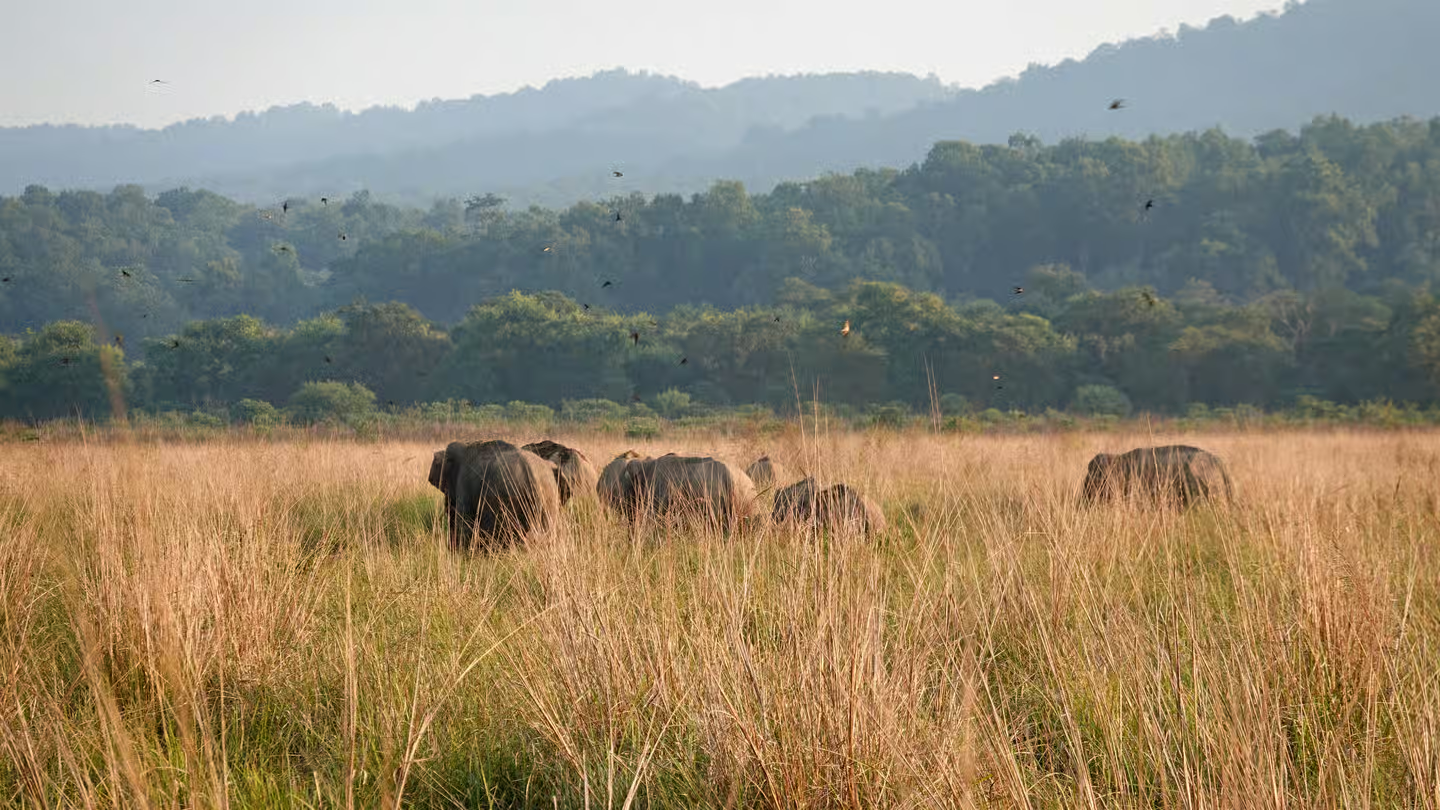
Jim Corbett National Park does not show its tigers readily. You are sitting in a jeep at Dhikala, one of the most celebrated wildlife-viewing locations in Asia. The Ramganga river is twenty metres to your left. Ahead of you, three metres of elephant grass stretches to the tree line, maybe a hundred metres away. The grass is moving. Not the wind. Something large, pushing through it, left to right. Your guide whispers that a tigress is walking the edge of the chaur. You can hear her. You cannot see her.
Jim Corbett National Park holds more tigers per square kilometre than almost anywhere on earth. In the latest all-India tiger estimation, from 2022, its density sits at 19.56 per 100 square kilometres, among the highest recorded anywhere in the world. It is a remarkable number. It is also, for the visitor who has travelled across India or from the other side of the world to see a tiger, the most misleading number in Indian wildlife tourism.
What the density figure actually means
Tiger density is a measure of how many tigers a landscape can support. Corbett's terai floodplain, with its tall elephant grass, riverine forest, year-round water from the Ramganga system, and vast prey herds, is among the most productive wildlife habitats in Asia. It can sustain more tigers per square kilometre than almost any other forest on the continent. The number is not in question.
The question is what happens when you put a visitor in a jeep and send them into that landscape.
Corbett's core zones are dominated by dense sal forest and elephant grass that reaches three metres in the growing season. A Bengal tiger in that grass is effectively invisible unless it chooses otherwise. You can be forty metres from one and drive past without a flicker of movement. The dense lantana scrub that chokes parts of the forest floor makes the problem worse. Tigers are there. The forest is doing exactly what a healthy forest should do: hiding its predators.
The grasslands, the chaurs, are where sightings concentrate. Dhikala's famous chaur, the vast open grassland along the river, is genuinely extraordinary. On a good morning in peak summer, when the grass has been grazed down and water draws animals to open ground, you can see tigers from a distance. May is the sweet spot, the month when operators report the Dhikala odds at their best. But a good morning at Dhikala is not the same as a reliable morning. And Dhikala is not easy to get into.
What Corbett actually offers
Corbett is India's oldest national park, established in 1936, and its reputation is deserved. The Ramganga river system, the sal forests, the sheer abundance of life in the terai landscape, these are real and magnificent.
Eight tourism zones operate within the reserve. Dhikala, the most celebrated, sits deep inside and is accessible only to overnight guests staying in forest rest houses or via canter, the large multi-row vehicle that carries sixteen passengers along a fixed route. Bijrani and Jhirna are the main jeep zones. Dhela and Durga Devi offer quieter, less-visited circuits; Garjiya, Sonanadi and Pakhro round out the list, each with its own entry point and character.
The vehicle limits are far more generous than Tadoba's. Bijrani and Jhirna each send thirty gypsies per session, Dhela and Durga Devi on smaller quotas, with Dhikala adding two sixteen-seat canters per shift on its fixed route. On a full day that is well over a hundred and fifty vehicle movements across the main zones: a density of traffic visitors feel on the track long before they ever read about it.
The monsoon reshapes the calendar more thoroughly than most visitors realise. Night stays across all zones are suspended from 15 June to 14 November. The core day-visit zones follow their own windows: Bijrani closes for day visits from 30 June to 14 October, while Dhikala and Sonanadi are shut from 16 June to 14 November. Only Jhirna and Dhela keep running through the rains, subject to road and weather conditions. The celebrated core experience (Dhikala, Bijrani, Durga Devi) is really a winter and summer-season affair.
Access is from Ramnagar, roughly five and a half hours from Delhi by road. The drive is part of the experience for those already travelling through Uttarakhand. For someone flying in specifically for a safari, it is a commitment.
Why Tadoba's number tells a different story
Tadoba's tiger density, measured over the surveyed, camera-trapped area in the 2024 Phase IV monitoring, comes to 7.18 per 100 square kilometres. A fraction of Corbett's. On paper, it is not close. Strictly speaking the two figures come from different surveys and should not be weighed against each other directly. Which is rather the point.
Yet bear with us, because this is where the numbers stop being the point. By Limban's own guest records, a guest doing two or three safaris at Tadoba has better than an 80 per cent chance of seeing a tiger. Across nearly a decade of hosting guests and managing their safaris at Limban, we can count on one hand the guests who finished three drives still waiting. It is what happens when a readable forest meets a genuinely abundant tiger population.
Tadoba's dry teak and bamboo forest thins dramatically during summer, the peak safari season. The canopy opens. The undergrowth drops. The forest becomes, in the most practically useful sense, legible. Waterholes concentrate animal movement at predictable times. Clearings and open track junctions create sightlines that do not exist in a dense floodplain landscape. A tiger moving at dawn in this terrain is not hidden by its habitat. It is framed by it.
The vehicle limits reinforce the difference. Moharli, Tadoba's busiest core gate, operates on controlled numbers. Navegaon allows six jeeps per session. Pangdi allows two. On a quiet morning in the buffer, you can go an hour without seeing another vehicle. The forest sounds like a forest.
The vehicle problem nobody warns you about
This is where the numbers stop being abstract.
At Corbett, the canter at Dhikala carries sixteen passengers along a fixed loop. You see what the route offers. The driver stops where the route allows. You are one of many, on a schedule, in a vehicle built for capacity rather than intimacy.
Even in the jeep zones, the vehicle density during peak season means that a tiger sighting, when it happens, often draws every available vehicle within range. The track fills. The moment is shared, often from multiple angles, often at distance.
At Tadoba, the tight gate limits mean something different. A guide who finds a tiger can stop and wait. There is no convoy building behind you. There is no pressure to move on. You watch the animal on something closer to its terms than yours. This is not a small thing. It is the difference between seeing a tiger and experiencing one.
The practical layer
Timing works differently in the two parks, and it is worth knowing before you book.
Corbett's core season runs from mid-November to mid-June. November and December are cool and pleasant, February and March the comfortable middle, and the grass is at its shortest in April and May, when tiger sightings on the core chaurs peak. Booking ahead matters more here than almost anywhere in India: Dhikala's forest rest house night stays open for reservation about six weeks out, and the canter's sixteen seats for peak dates go fast. If you are not organised, you may find yourself in Jhirna or Dhela, the year-round southern zones, which hold tigers but not the classic chaur experience.
Tadoba runs October to June with the same summer peak but a different lead-time problem. Five to six weeks ahead you can still recover permitted windows at most gates; the famous ones, Moharli and Navegaon, fill earlier in the hot months. The famous Tadoba mornings are April and May, when the waterholes concentrate the forest; the same reason Corbett hunters chase May, with far better odds of the encounter actually happening.
The real comparison
Corbett's density is real. The 19.56 figure represents a landscape that has been protected for ninety years and has responded with extraordinary abundance. The terai ecosystem, the Ramganga river system, the sheer biomass of the grasslands: these are among India's greatest conservation achievements. Nobody who cares about wildlife should dismiss what Corbett represents.
But a visitor choosing between these two parks is not choosing between conservation records. They are choosing between two fundamentally different ways of spending two or three mornings in a jeep.
Corbett offers the terai, the river, the vast grasslands, the oldest national park in India. It offers the possibility of a tiger sighting that, if it comes, is framed by one of the most beautiful landscapes in Asia. It also offers a realistic chance of three drives through magnificent forest without a clear sighting at all. The density is there. The visibility is not guaranteed.
Tadoba offers a forest that cooperates. The teak opens, the waterholes concentrate, the sightlines align, and the tiger, when it appears, appears close. Not at a hundred and fifty metres through binoculars, but at fifteen metres, crossing the track ahead of you, unhurried, aware of you, indifferent to your presence. The density is lower. The encounter rate is not.
These are different trips. Neither is wrong. But the density figures that sell Corbett do not tell you which one you are booking. We have made a similar argument about Ranthambore, Kanha, Pench and Bandhavgarh: the numbers that market a park are not always the numbers that describe the experience. Comparing more than these two parks? All fifteen Tadoba verdicts stand side by side in the India Tiger Parks series.
If you want the terai landscape, the river at dawn, India's oldest park, and you accept that the tiger may remain hidden, Corbett is worth the journey. If seeing a tiger, reliably and up close, is the point of the trip, Tadoba is not even a close contest.
We had a morning last April. Khutwanda gate, first light, a tigress and two sub-adults at a waterhole. Twenty minutes, no other vehicles, the forest still cool. That is not a Corbett morning. It is not meant to be. It is what this particular forest, in this particular landscape, does with unusual consistency.
Planning a Tadoba safari?
If Tadoba is your destination, stay at Limban and safari from Limban. Tell us your dates and we plan both halves together: room and forest, confirmed before you arrive. Start the Conversation →