Tadoba Safari Gates: Where You Stay Changes Everything
Tadoba is larger than Greater London, yet most resorts sit close to just one gate — and leave you guessing about the others. Where you stay determines what time your alarm goes off, how long you drive in the dark, and whether a 3-hour safari costs you 4 hours - or 8.

Archana Bhagat Schäfer
Published 20 March 2026
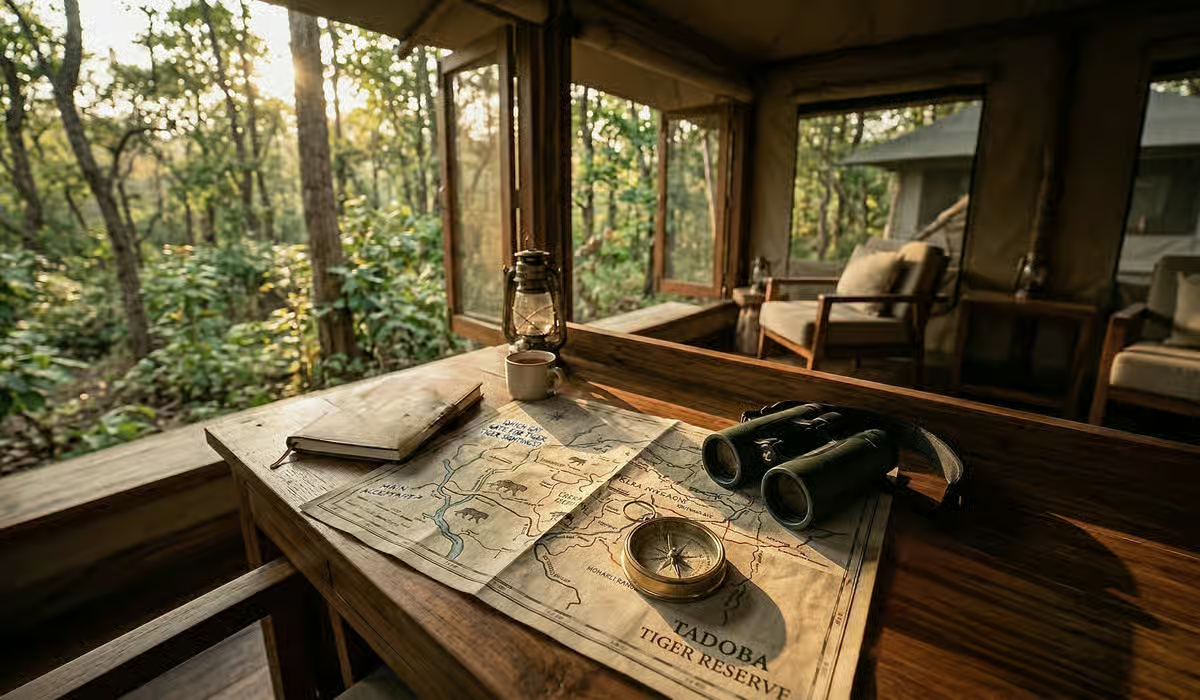
There is a specific kind of frustration that settles over a traveller somewhere around 4:45 in the morning. They are three-quarters of the way through a two-hour drive across rural Maharashtra in the dark, their coffee a memory, the road a suggestion, and their luxury safari holiday already feeling like something that is happening to someone else. They booked the right reserve. They got the permits. They simply got the geometry badly wrong.
This is not a rare story. It plays out every single season across Tadoba Andhari Tiger Reserve, and it happens because almost every piece of planning information available to travellers — blogs, aggregators, OTA listings, even some official sources — treats this 625-square-kilometre forest as though it were a convenient, manageable dot on a map. It is not. And understanding why that matters is the difference between a safari that rewards you and one that merely exhausts you.
What we hear from guests, consistently, is this: two days is where the forest starts to make sense. By the third drive, the pieces — territory, water, alarm calls, timing — begin to connect. The "luck" of the first morning gives way to something that feels more like reading. Though as any naturalist will tell you, the forest always gets the final vote.
Tadoba Is Not Small. Maps Can Be Deceiving – Or Just Wrong.
Open any travel site and pull up Tadoba. The reserve sits there looking like a tidy green oval in central Maharashtra, its various gates scattered around the perimeter at what appear to be modest, navigable distances from one another. The visual logic can be misleading and is often choreographed to appeal.
The reserve stretches roughly 50 kilometres north to south. The forest itself — dense teak, tangled bamboo, deeply rutted tracks — acts as a physical wall between the zones. There is no cutting across. There are no shortcuts. Getting from the northern Kolara gate to the southern Moharli gate is not a park crossing; it is a full circumnavigation on rural roads, in the dark, before dawn, and it takes the better part of two hours each way.
A verified, accurate map of Tadoba's safari gates is surprisingly hard to find. Existing online maps are frequently wrong: gates are mislabelled, core zones are marked as buffer, and distances are either omitted or estimated so generously as to be useless.
Our interactive map below is built from current forest-department data, on-ground GPS readings, verified maps and actual drive-time data, and is the reference we wish had existed when we started off in Tadoba:
Tadoba's Safari Gates Map
The Gates: What’s What, Where They Really Are
Tadoba currently operates more than 20 safari gates in total, divided into three tiers: Core Zones (the primary, high-density forest), Buffer Zones (the vital wildlife corridors bordering the core), and the Territorial Forest Safaris — quieter, often overlooked extensions managed by the territorial forest division.
All drive times in the tables below are measured from Limban Resort, which sits at the natural junction of the greatest concentration of quality safari options in Tadoba. If you are staying elsewhere, your exact timings will change, but the geometry — which gates are close, which are a stretch, and which are essentially a different side of the park — will not.
Core Gates - From Limban
Gate | From Limban | Drive Time | What To Know |
|---|---|---|---|
| Khutwanda | 6 km | 15 min | The closest core gate from this corridor. Direct road, no detours. Ideal anchor for core safaris without punishing wake-ups. |
| Moharli | 13 km | 25 min | Tadoba’s most celebrated gate. High tiger density, long history of famous individuals, lakes and meadows — also the busiest entrance. |
| Navegaon | 46 km | 65 min | Core gate into the Navegaon–Ramdegi corridor, with a distinct wetland and stream landscape. |
| Kolara | 69 km | 100 min | Northern core with a different character: more closed forest and rocky terrain. Worth the extra drive for variety. |
| Zari | 74.5 km | 112 min | Deep south core on the Kolsa side. Less trafficked, atmospheric, with a genuinely wild feel when time allows. |
| Pangdi | 107.7 km | 145 min | Remote Kolsa-side core. Best kept for longer, slow-travel itineraries. |
Buffer Gates - From Limban
Buffer zones in Tadoba are consistently underrated. They share seamless boundaries with the core, carry far fewer vehicles, and regularly produce spectacular big-cat sightings. Several are also the only places in the reserve where walking and cycle safaris are permitted.
Gate | From Limban | Drive Time | What To Know |
|---|---|---|---|
| Junona | 13 km | 22 min | Sits just a kilometre from the Moharli core boundary. Dense, atmospheric, far less crowded than core. |
| Agarzari | 17.7 km | 28 min | Home to Tadoba’s walking and cycle safaris, offering a completely different register of experience. |
| Devada-Adegaon | 18 km | 32 min | Moharli-belt buffer with direct wildlife overlap, offering a quieter safari with far fewer vehicles. |
| Nimdela | 36 km | 60 min | Navegaon-side buffer that feels genuinely immersive and remains quieter than many headline gates. |
| Ramdegi-Navegaon | 48 km | 70 min | Navegaon-belt buffer in a scenic valley, known for leopard movement and active breeding territory. |
| Mamla | 54 km | 90 min | Southern buffer off NH930. The outermost option from Mudholi. |
| Alizanja | 68 km | 100 min | Far northern buffer, part of the Kolara corridor. Long drive, distinctive forest character. |
| Keslaghat | 68 km | 90 min | Southern Kolsa buffer with mature teak, offering excellent sloth bear habitat and minimal safari traffic. |
| Zari Peth | 71 km | 100 min | Buffer companion to Zari Core, sharing the Kolsa range's bamboo and sloth bear habitat. |
| Madnapur | 73.4 km | 90 min | Kolara-side buffer reached via perimeter drive. Quiet, less-trafficked forest for those who enjoy going further out. |
| Kolara Chouradeo | 74 km | 115 min | Kolara-belt buffer sharing territory with the core, providing a quieter entry option. |
| Belara | 75.5 km | 115 min | Kolara-belt buffer via forest roads. Peaceful, rarely discussed in mainstream planning. |
| Palasgaon | 78 km | 120 min | Quiet buffer gate with denser, more enclosed vegetation, ideal for a peaceful morning. |
| Sirkada | 84.4 km | 115 min | Remote buffer with deep-forest tracks. For guests who want to go off the standard circuit. |
| Pangdi Aswal Chuha | 109 km | 150 min | Pangdi-side buffer that shares serious wildlife territory. Remote, serious forest. |
| Somnath | 122 km | 163 min | The southernmost buffer accessing the Mul forest range, offering unhurried wildlife sightings. |
Territorial Forest Safaris – The Exploratory Tier
Often omitted from standard planning maps, these gates are managed by the Territorial Forest Division rather than the Wildlife Division. They offer a "rawer," less-regulated experience in the teak-heavy extension forests. These zones — such as Chora-Tirwanja and Shedegaon — are ideal for repeat visitors who have already covered the core highlights and are looking for a quieter, unvarnished forest pace. We facilitate these from Limban for those who want to go genuinely off-circuit.
Gate | From Limban | Drive Time | What To Know |
|---|---|---|---|
| Chora-Tirwanja | 21 km | 35 min | A highly accessible territorial zone. Quiet, atmospheric, and an excellent alternative to the busier buffers. |
| Shedegaon | 49 km | 71 min | Managed extension forest in the northern belt. Raw terrain, few vehicles. |
| Lohara | 62 km | 95 min | Southern extension territory. Deep forest character, best for the patient observer. |
| Karwa | 73 km | 110 min | The outermost territorial gate. Genuinely wild teak stands with virtually zero vehicle pressure. |
Boating Safaris – The Riverine Perspective
Beyond the teak and bamboo, Tadoba's ecology is anchored by the sprawling backwaters of Irai Lake. Sitarampeth is not a traditional forest gate at all; rather, it is a dedicated eco-tourism boating point managed by the forest department. A short 15-minute drive from Limban Resort, it offers a completely different register of experience. From the water, the forest edge reveals itself differently: marsh crocodiles sunning on the mud banks, remarkable bird watching opportunities, and a profound, unhurried quiet that simply cannot be found from the back of a jeep. It is an outstanding addition to a longer stay, offering a necessary shift in pace.
Boating | From Limban | Drive Time | What To Know |
|---|---|---|---|
| Irai Lake | 6 km | 14 min | Not a traditional gate, but an eco-tourism boating point. A 14-minute leisure ride from Limban opens up the vast backwaters of Irai Lake for spectacular birding and crocodile sightings. |
The working rule is straightforward: If your accommodation is not within about an hour of the gate your permit is booked for, your safari holiday has quietly become a logistics operation. The forest does not adjust its schedule for a late arrival.
What the Tables Do Not Show
Distance and drive time are only half of the gate geometry argument. The other half is this: the gates are not interchangeable entrances to the same place. Each one opens into its own distinct internal circuit — a separate road network, a different landscape character, a different set of waterholes and territories.
The Moharli circuit fans out around Telia Lake and the famous western meadows. The Tadoba Lake circuit, entered from the northern gates, is a completely different landscape — more open water, different prey concentrations. The Kolara and Navegaon circuits run through closed forest and rockier terrain in the upper core. None of these internal networks connect to each other. A permit for Moharli gets you the Moharli zone. You cannot drive through to Tadoba Lake from inside. You cannot cross to Kolara's circuit mid-safari.
This means that even if all gates were equidistant from your accommodation, they would still not be the same experience. The southwest cluster — Khutwanda, Moharli, Junona, Agarzari — is not redundant just because the gates sit close together. Each opens a different room. From a base in this corridor, a guest on a four-night stay can cover four genuinely distinct zones: different terrain, different tiger territories, different light. That variety is not available from anywhere else in Tadoba.
Did You Know?
In Tadoba Andhari Tiger Reserve, entry and exit are strictly tied to the same gate. You always exit through the same gate you entered.
Why the Southwest Corridor Changes Everything
Limban sits near Village Mudholi, anchored in the south-western corner of the reserve. This is not incidental placement; it is the single geographic position from which the greatest variety of quality safari options in Tadoba are accessible within a reasonable, comfortable drive.
Khutwanda Core is around 15 minutes away. Moharli Core is about 25 minutes. Junona Buffer is 22 minutes. Agarzari is 28. On a four-night stay, a guest can meaningfully explore four distinct zones without ever setting an alarm before 5:30 am.
This corridor also offers immediate access to Irai Lake — the expansive reservoir that borders Tadoba's south-western edge and opens up an entirely different dimension of the experience for boating and birding.
What a Few Days in the Southwest Actually Looks Like
A single drive tells you the forest exists. Three or four days here begin to tell you how it works — and the southwest is where that depth is most easily earned.
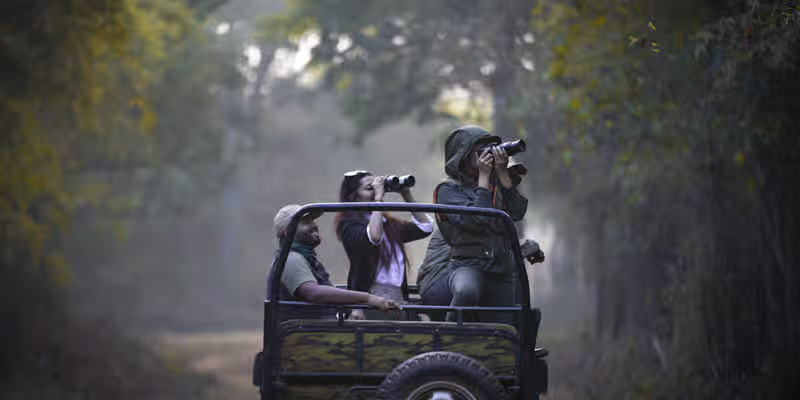
The foundation is the classic open-top Jeep safari at first light into Khutwanda or Moharli: the 5:30 alarm, the cool air, a naturalist reading pugmarks and alarm calls while the forest is still settling. Most guests start here, and most leave wanting one more morning. That impulse is worth following.
The full-day safari belongs on a longer itinerary — not as an endurance test, but as the format where everything shifts. Animals that moved away from vehicles at 7 am stop noticing them by noon. Being 15 minutes from the gate means arriving first and leaving last, without a 3 am start that flattens the day before it begins.
From the second or third evening, Irai Lake offers a natural change of pace. From the water, the same forest looks entirely different — quieter, wider, its edge suddenly visible. It takes minutes to reach from Limban, and it never fails to surprise guests who thought they already had the measure of the place.
The photographic and birding mornings are the quieter garnishes of a well-paced stay. A modified jeep with beanbag supports, a guide thinking in terms of light and sightlines rather than checklists. Or a morning in Agarzari or Junona buffer — unhurried tracks, 280 documented species, far less vehicle pressure than the core, and the kind of access that serious birding actually requires. Both sit best towards the end of a stay, once the forest is already familiar and attention has had time to deepen.
None of this requires complicated logistics. From this corner of the reserve, it is simply what a few good days here look like.
Plan your stay at Limban Resort and let us help you get the most out of your Tadoba trip.
More Interesting Reads
115 Tigers. And Why The Number That Matters Most Is Not That One.
Tadoba's tiger density is a fraction of Corbett's or Bandipur's. Yet its sighting rates are among the highest in India. The gap between those two facts is the real story, the one nobody is talking about.
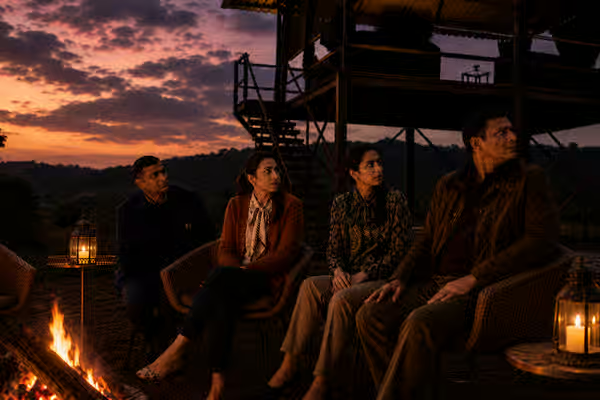
Tuning In: Why You Should Read Tadoba With Your Ears
Most guests arrive waiting to see the wildlife. The real secret is learning how to listen to it, especially after dark.
Two Full Bathrooms In Every Room? This Detail Matters. Here's why.
Nobody should be queuing up at 5am to get ready when the jeep is already out waiting. You will only really get this on your first morning here. Here's why such details matter.
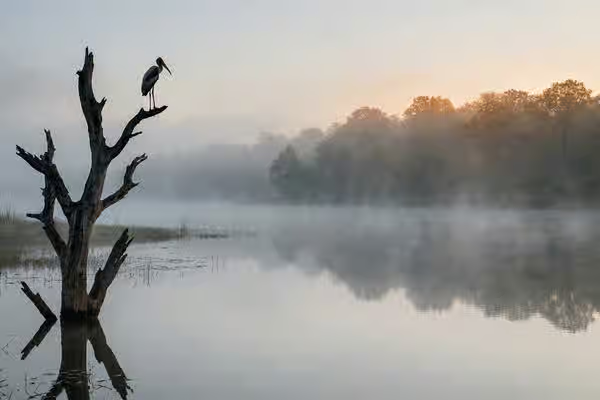
The Birding Safari at Tadoba: Why It Deserves a Trip of Its Own
Over 280 documented species, an IBA-designated forest, and mornings that have nothing to do with tigers. A complete guide to one of Central India's most overlooked wildlife experiences.
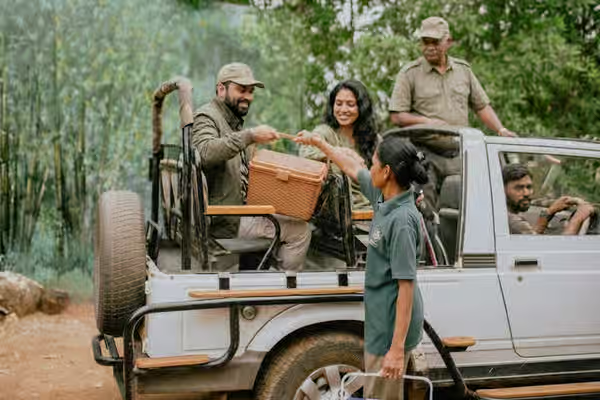
Core Zone or Buffer Zone? Here's What We Actually Tell Our Guests
The hierarchy of core over buffer is one of the most persistent myths in Indian safari planning. Here is what actually matters.
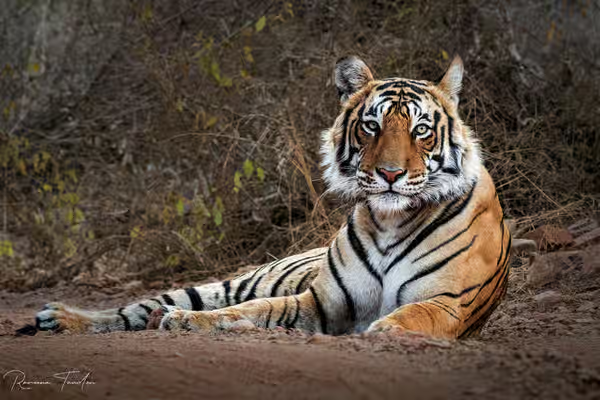
Tadoba vs Ranthambore: An Honest Comparison for Your First Tiger Safari
Two of India's finest tiger reserves. Two very different arguments for why you should visit them. We are going to make the case for both.