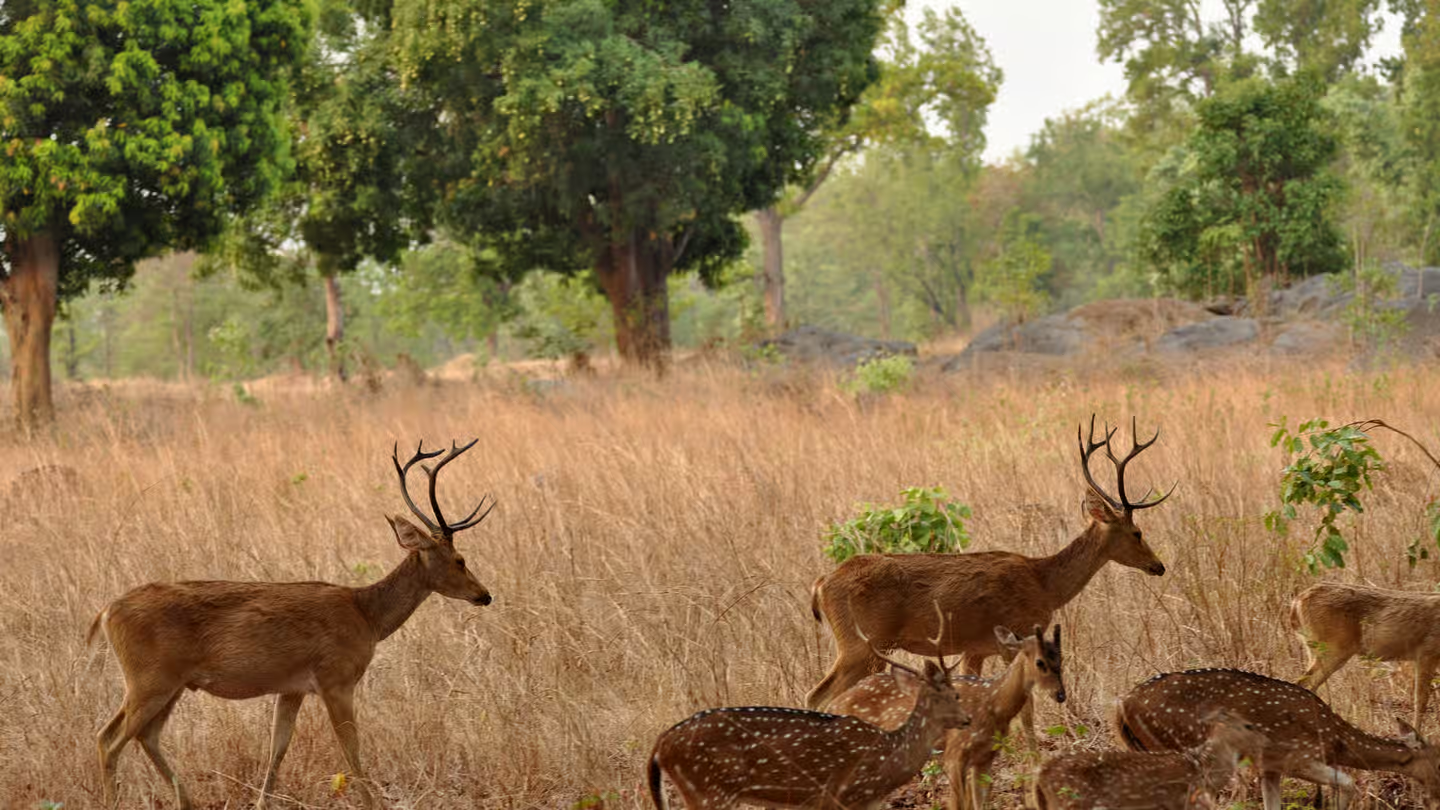
Kanha Tiger Reserve starts with an engine cut and a hand up. Ahead, across two hundred metres of short grass, a tigress is lying in the open, head up, watching you. She has been watching since you arrived. Between you and her, nothing but open meadow. You can see her clearly. She can see you.
That is the signature of Kanha Tiger Reserve. The maidans, the vast central grasslands enclosed by ridges on three sides, are some of the best wildlife-viewing terrain in Asia. They are the reason Kanha's tigers are seen with a regularity that few Indian reserves match. Not because there are more of them, but because the landscape itself cooperates.
Tadoba does not have meadows like these. What it has is dense teak and bamboo forest, drier, with narrower sightlines. When a tiger appears at Tadoba, it is often at close range: the guide stops, raises a hand, and the animal is there, crossing the track twenty metres ahead of you. The encounter is defined by proximity, not distance.
Both reserves produce tiger sightings. The experience of those sightings is fundamentally different.
The landscape question
Kanha sits in the Maikal hills of the Satpura range, split between the Banjar river valley in the west and the Halon valley in the east. The terrain is a mix of sal forest, bamboo, and those famous meadows.
The meadows are not an accident of nature. They are the result of one of India's most remarkable conservation decisions. By around 1970, the hard-ground barasingha, the swamp deer that gives Kanha much of its identity, had crashed to just 66 animals. The entire surviving subspecies on earth, concentrated in a handful of grasslands in the park's core. The response was radical. Village after village was relocated out of the core. Thousands of hectares of grassland were restored. Invasive species were cleared. Breeding enclosures were built. The barasingha recovered, from 66 to over a thousand by 2023.
Those restored grasslands became the park's defining feature. They are what make the meadows so extraordinary for wildlife viewing. A tigress lying in short grass, visible from a hundred and fifty metres, is possible because of a decision made fifty years ago to save a single species. The landscape was deliberately opened. The viewing was, in a sense, engineered.
Tadoba's forest was never deliberately opened. It is a dry teak and bamboo forest that thins naturally in summer, the peak safari season. The canopy drops. The undergrowth recedes. The sightlines improve, but they remain narrower than Kanha's meadows. What Tadoba offers is not open terrain but intimate terrain. The tiger is close. The forest is around you. The encounter happens at a distance measured in metres, not hundreds of metres.
What the numbers tell you and what they do not
Kanha's core zone covers 940 square kilometres, with a buffer of 1,134. India's most recent published national estimate, the All India Tiger Estimation 2022, put the reserve's tiger population at 105. It is the latest official figure for Kanha on public record. Conservation cycles move slowly, and the number will be revised when the next estimation is published.
Tadoba's core and buffer together stretch across roughly 1,727 square kilometres, with 95 adult tigers recorded in the 2024 Phase IV monitoring, plus 41 cubs and sub-adults. Note the different counting conventions: Kanha's figure is a total population estimate from the national cycle, Tadoba's counts adults from a later state monitoring round. Across Limban's own guest records, the sighting rate at Tadoba runs consistently above 80 per cent across most gates and seasons.
The comparison is not, in any case, about which park has more tigers. Nobody chooses a two-morning safari by comparing population totals on a spreadsheet. What the numbers never capture is what happens in the terrain between them. The number tells you a park holds tigers. The terrain tells you whether you will meet one, and how that meeting will feel. That is the story we are telling here.
At Kanha, the meadows allow you to observe a tiger at distance, watching it move through its landscape, seeing how it uses the terrain. The sighting is expansive. You understand the animal in context.
At Tadoba, the forest compresses the encounter. The tiger appears close. The moment is immediate and personal. You are not watching from across a field. You are fifteen metres away, and the animal is aware of you.
Neither encounter is better. They are different ways of being in the presence of the same animal. What you prefer says more about you than about either park.
The barasingha factor
The barasingha is Kanha's signature beyond the tiger, and its story is worth knowing.
The hard-ground subspecies, Rucervus duvaucelii branderi, exists nowhere else on earth. It was saved from extinction within these meadows, through one of the most sustained and deliberate conservation efforts in Indian wildlife history. Translocation programmes have since moved animals to Satpura and Bandhavgarh, building satellite populations to reduce the risk of a single-site catastrophe.
For the visitor, the barasingha adds a layer to the safari that Tadoba does not have. Watching a herd of twenty, the males in velvet antler, moving through the meadow at dawn, is not a tiger sighting. It is something else entirely: a conservation story you can see with your own eyes, playing out in real time, in a landscape that was reshaped to make it possible.
Tadoba has its own conservation narrative, quieter and less dramatic. The recovery of the tiger population from a handful to nearly a hundred adults in two decades, the voluntary relocation of villages from the core, the slow restoration of the prey base. But there is no single species, no single story, that defines Tadoba the way the barasingha defines Kanha. Tadoba's identity is the forest itself: rough, dry, dense, honest.
The tourism question
Kanha has three main entry points: Khatia, Mukki, and the more recently opened Sarhi. Khatia and Mukki sit an hour or more apart by road, each with its own cluster of resorts, lodges, and guide networks. The tourism infrastructure is mature. You will find well-marketed lodges, experienced operators, established circuits.
Tadoba operates more than twenty gates, but the infrastructure is less polished. Resorts cluster near Moharli and Khutwanda in the southwest corridor, and the tourism economy around Chandrapur district is still more working town than safari destination. That is not a criticism. It is a description of character.
Kanha feels like a park that has been marketed well. Tadoba feels like a park that has not needed to be. Both attract serious wildlife visitors. The atmosphere is different.
The vehicle pressure tells its own story. Kanha's zones process several hundred vehicle movements on peak days. Tadoba's gates, by contrast, operate on tighter limits. Moharli, the busiest, handles a fraction of what Kanha's Khatia and Mukki zones process together. The buffer zones, Junona, Agarzari, Devada, are quieter still.
The difference matters. At Kanha, a good sighting can draw a crowd. At Tadoba, the tight limits mean that when something happens, it tends to happen with space around it.
Getting there
Kanha requires a longer approach. Nagpur to Khatia gate is roughly five to six hours by road. Jabalpur is about four hours. The drive through Mandla has its own character, but it is a commitment, particularly for a short trip.
Tadoba sits two and a half to three and a half hours from Nagpur, depending on which gate you are booked into. That difference matters for a three-day visit. Arriving after a shorter drive means you start the next morning fresher, and in a forest where the first drive at dawn is often the best, freshness counts.
Both parks close their core zones for the monsoon, roughly July to mid-October. Tadoba keeps some buffer zones open. Kanha's core shuts entirely and reopens in mid-October, but its buffer zones (Khatia, Khapa, Sijhora, Phen) run through the rains, so the reserve is never fully closed. The post-monsoon months at Kanha, October and November, are among the finest in Central India: the meadows still green from the rains, the animals spread across the landscape, the park at its most alive.
When to go, and how far ahead to book
Kanha's prime season is October to June. October and November are the classic post-monsoon months, February to April the reliable middle, and the hot weeks of May the peak for tiger encounters on the open maidans. Booking builds differently than at Tadoba: the mature lodge network sells its known operators first, and the best guides are gone early for the winter months. If you want a specific lodge and a specific gate, three to four months is a safer runway than two.
Tadoba's season is the same span, October to June, with the same hot-month peak. The difference is lead time. Five to six weeks ahead still recovers most gates, Moharli and Navegaon being the exceptions in April and May. Which is to say: both parks reward planning, but the planning horizon differs by months.
So which one
Kanha is the park for someone who wants the meadows. The open terrain, the barasingha, the sense of a vast, well-managed reserve with a conservation story at its heart. The polished infrastructure. The option to see a tiger at distance, in context, in a landscape that was shaped to make such sightings possible.
Tadoba is the park for someone who wants the forest. Dense, dry, rough around the edges, producing encounters at close range with a consistency that few reserves match. The tighter vehicle limits. The quieter mornings. The sense that the forest has not been rearranged for the visitor's convenience.
These are not competing claims. They are different answers to the same question: what kind of morning do you want to have in the jungle? Comparing more than these two parks? All fifteen Tadoba verdicts stand side by side in the India Tiger Parks series. The answer keeps coming back to the same thing: it depends on what you want from the forest.
If the answer is open meadows, distant tigers, and a conservation story that rewrote the landscape, Kanha is your park. If the answer is close encounters, dense forest, and a reserve that feels like it belongs to the animals, Tadoba is ours.
Come and see which one stays with you.
Planning a Tadoba safari?
If Tadoba is your destination, stay at Limban and safari from Limban. Tell us your dates and we plan both halves together: room and forest, confirmed before you arrive. Start the Conversation →