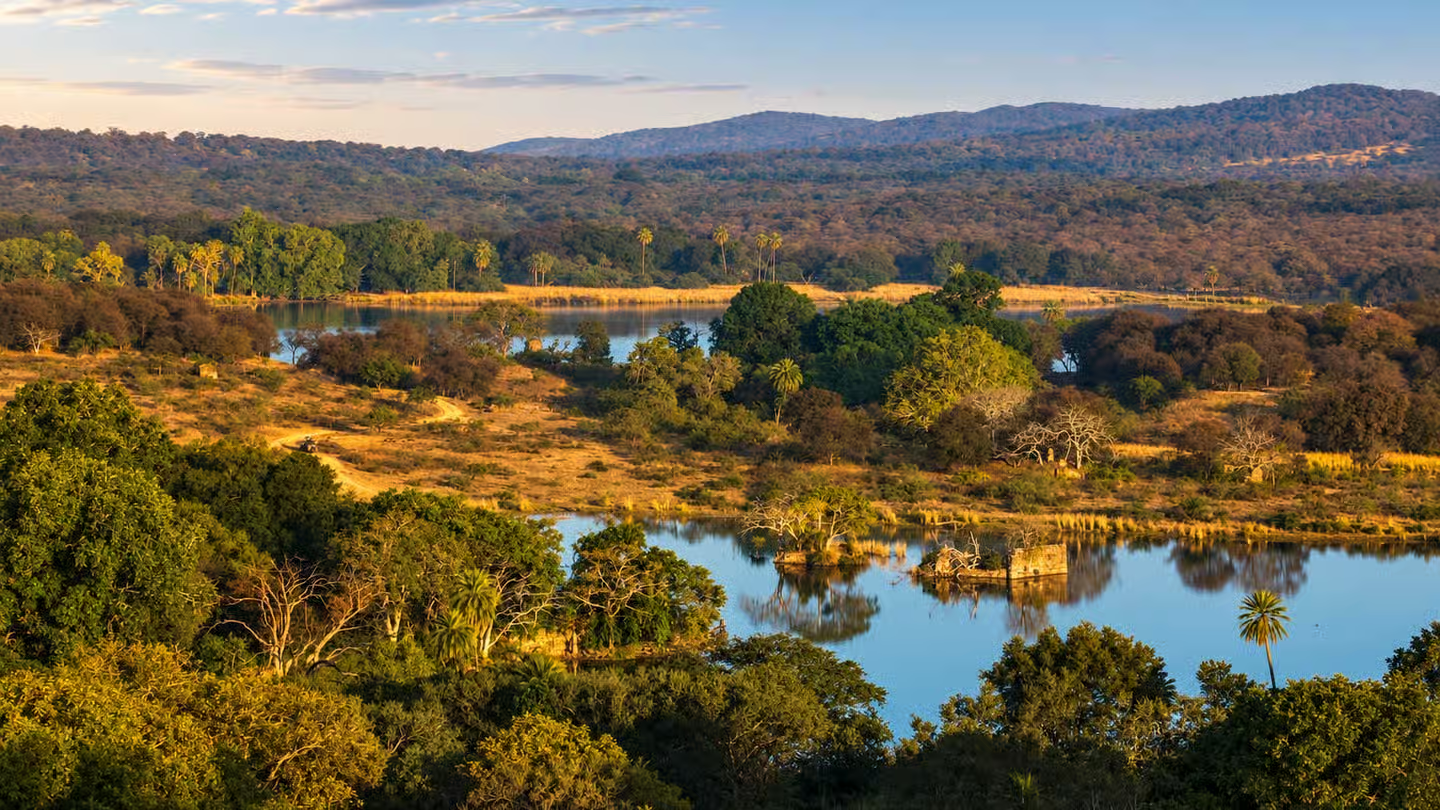
First light on Ranthambore's lake: mist, a sambar's alarm call rolling off the water, the fort still invisible above it. Then the tiger steps out of the treeline and the whole shoreline seems to hold its breath. Nobody who has watched that morning should have to defend it.
Tadoba or Ranthambore National Park: two of India's finest tiger reserves, and two very different arguments for visiting them. Our home is in Tadoba, and we would still rather you arrived knowing exactly what you were choosing, and why.
Start with a better question
Most people frame this as a quality comparison. Ranthambore National Park versus Tadoba, prestige versus probability, Rajasthan romance versus Vidarbha wilderness. That framing leads to disappointment.
The real question is: what do you actually want from two days in a jeep?
If you want a photograph that exists nowhere else on earth, a tiger moving through ancient ruins with the old fort dissolving into morning mist behind it, Ranthambore is your answer and it always will be. Anyone who dismisses that image as touristy is being precious about someone else's experience.
If you want to actually see a tiger, reliably, unhurriedly, with space around the sighting, the odds point the other way, and not subtly.
Both are true. Neither cancels the other out.
What the numbers say
India's 2024 Phase IV monitoring places Tadoba at around 95 adult tigers, with another 41 cubs and sub-adults photographed alongside them, spread across roughly 1,727 square kilometres of core and buffer forest.
Ranthambore's most recent official estimation counted around 70 tigers across 1,411 square kilometres: a strong population, differently arranged. Note the counting conventions differ, as they do everywhere in this series. Tadoba's headline figure counts adults from a later state monitoring round, Ranthambore's is a total-population estimate. The honest comparison is not the totals but the terrain they sit in. Ranthambore's cats are concentrated in a handful of zones. Tadoba's are spread across a forest that still has room to breathe.
Across Limban's own guest records, sighting probability at Tadoba runs consistently above 80 per cent across most gates and seasons. At Ranthambore, on operator-reported figures, it is around 35 to 45 per cent.
So, if you have travelled across India, or halfway around the world, for two to five mornings in the forest, those numbers are the difference between hoping for a tiger and actually seeing one or even several. You are twice as likely to see a tiger in Tadoba as in Ranthambore.
Do two or three proper safaris in Tadoba and the stats work in your favour.
The crowd problem nobody warns you about
Ranthambore runs well over a hundred vehicles per safari shift, gypsies and canters spread across ten zones. On a busy winter weekend you will feel every one of them. There is a particular frustration in watching a tigress with cubs while a canter full of tourists reverses into your sightline. On a quiet weekday it can still be sublime, which is precisely why the winter weekends hurt.
Tadoba caps its gates rather tightly. Navegaon allows six jeeps per session. Pangdi allows two. Moharli, the park's most celebrated gate, sits about twenty-five minutes from Limban and operates on similar controlled limits. The difference in atmosphere is not subtle. On a quiet morning in the buffer you can go a full hour without seeing another vehicle. The forest sounds like a forest.
The tigers themselves
Ranthambore made its name on Machli, the most photographed tigress in history, a female who once fought a fourteen-foot crocodile and won, who raised litter after litter in full public view, who outlived every reasonable expectation through sheer stubbornness. She died in 2016. Her descendants carry her territory now. Arrowhead, one of her lineage, became famous enough that her death in 2025 made national news. Ranthambore's tigers are celebrities in the truest sense: named, tracked, narrated, anticipated.
Tadoba had Maya, whose decade around Tadoba Lake made her the most documented tigress in central India, a hunter of extraordinary patience. Waghdoh, the legendary Moharli male who died in 2022 at nearly twenty, left a lineage that still walks these firebreaks at first light, something people describe in the present tense for the rest of their lives.
These are wild animals. Sovereign, occasionally dangerous, entirely indifferent to you. That indifference is what you came for.
Where you sleep matters more than most admit
The safari is a few hours. The remaining hours are spent somewhere, and that somewhere can make or break the whole trip.
Limban sits on the edge of the buffer zone, fifteen minutes from Khutwanda Gate, twenty-five minutes from Moharli. Tigers move past the property, not occasionally, regularly. A leopard crossed the lawn two evenings running, unhurried, unbothered. Guests on the veranda at dusk have learned to keep the cameras close. The forest does not stop at the boundary, because the boundary is more suggestion than barrier.
That is the whole pitch for sleeping here: the safari starts before the gate and continues after it.
Getting there
Ranthambore sits four hours from Jaipur by road. If you are already doing a Rajasthan circuit, Delhi, Agra, Jaipur, then east, it fits naturally. The tourism infrastructure is mature and abundant.
Tadoba requires a touch more intention. The nearest airport is Nagpur, roughly 140 kilometres and two and a half to three and a half hours by road, depending on which gate you are booked into. There are direct flights from Mumbai, Pune, Delhi, Hyderabad, Bengaluru, and more. Nagpur is also a major regional railway hub with excellent connectivity. The drive from Nagpur through Chandrapur district is its own kind of preparation. The landscape changes, the edges of the road grow wilder, the air and light shift noticeably somewhere around the last hour. By the time you reach our gate you have already slowed to forest pace, ready for what's ahead of you.
That extra intention is a filter: fewer casual visitors, a quieter forest.
A word about seasons
October to February brings cool mornings, thin undergrowth and comfortable conditions. Good visibility, good temperatures, good for first-timers.
Ranthambore's winter is its own argument: mist on the lake at dawn, the fort appearing and dissolving above it, tigers moving through grass still green from the monsoon. If the photograph matters to you, this is when it is taken. The price is the crowd. These are also the busiest months, and the famous zones feel it first.
March to June is when Tadoba gets serious. The heat is not decorative, it is physical, and you should know that before booking May. But the waterholes concentrate every animal in the forest and sighting rates peak precisely because the landscape has nowhere left to hide. Some of the most remarkable encounters on record have happened in April at 11am when it was 43°C and sensible people were indoors.
Monsoon closes most of Ranthambore. Tadoba opens select buffer zones through the season if you know where to ask.
So which one then?
Ranthambore is worth it if you are already in Rajasthan, if that particular photograph matters to you, or if Machli's legend has a pull on you that is hard to explain rationally. These are legitimate reasons. The park is real and so are the tigers and some visits there stay with people permanently.
Tadoba makes sense if you want the highest probability of a close, unhurried encounter. If you shoot wildlife. If you want silence at 6am and something large and unhurried crossing the track fifteen metres ahead of your jeep.
Mornings like that one keep happening here. A tigress, three cubs, forty seconds, no other vehicles in sight.
Different parks, different arguments, the same question underneath all of them. Comparing more than these two parks? All fifteen Tadoba verdicts stand side by side in the India Tiger Parks series.
Planning a Tadoba safari?
If Tadoba is your destination, stay at Limban and safari from Limban. Tell us your dates and we plan both halves together: room and forest, confirmed before you arrive. Start the Conversation →